SensorLAB: Connect a Sensor.
Start an Experiment.
See Results.
Plug in a sensor:
Connect any compatible sensor to your ESP32!
Start an Experiment:
Live data, beautiful graphs and powerful tools.
Explore Real-World- Data: Weather, environment, motion, energy and more.
Save and Share:
Export your Data and use it for reports and analysis.
Measure. Export. Analyse.
From real-world measurements to student insights!
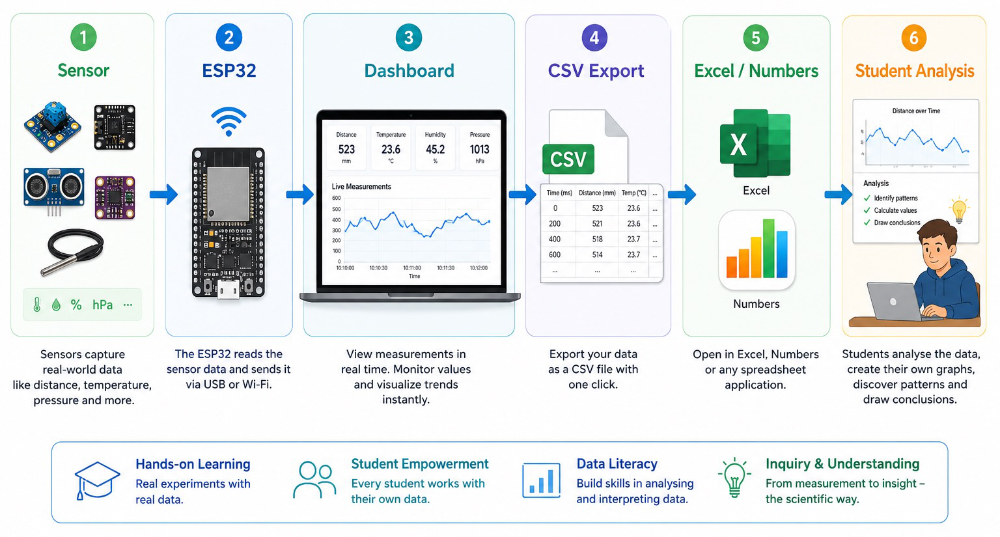
Gather real sensor data, export it as CSV, and explore it using Excel, Numbers, or Google Sheets. SensorLab enables every student to investigate, visualise, and understand real-world measurements independently.
Every student receives the measurement data and can analyse it independently.
No copying values from the board. Work directly with your own experimental data!
From Sensor to Dashboard in Minutes
Collect, visualise, record and analyze real-world-data using
ESP32, USB, Wi-Fi and browser based dashboards!
Welcome to SensorLab.world – a platform for simple, affordable, and modern sensor projects using microcontrollers, live data, and interactive visualizations.
The goal of SensorLab is to make real-world data collection and analysis accessible to everyone. Using low-cost hardware such as ESP32 development boards and a wide range of sensors, you can build your own weather stations, solar monitoring systems, IoT projects, and live dashboards without the need for expensive laboratory equipment.
SensorLab combines electronics, physics, programming, and data visualisation in a practical and easy-to-understand way. Sensor data can be collected via USB or Wi-Fi and displayed directly in a web browser on a PC, tablet, or smartphone.
Whether you are a student, teacher, maker, or simply curious about how sensors work, SensorLab provides an accessible way to explore measurement technology, data analysis, and real-world applications through hands-on experiments and interactive dashboards.
How Data Acquisition Works
with ESP32 and Sensors
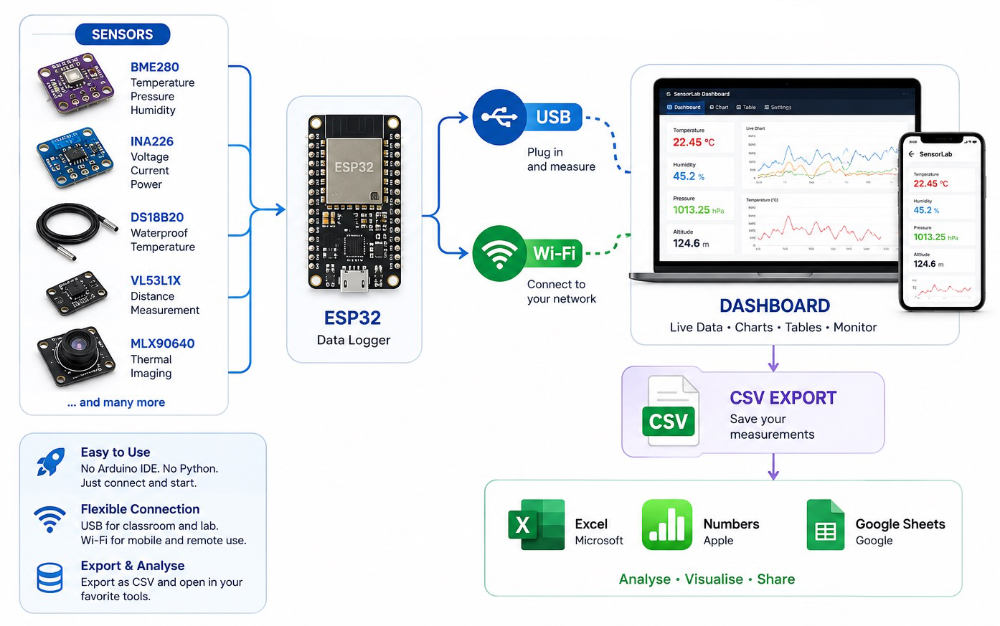
Sensors measure physical quantities such as temperature, air pressure, current, voltage, distance, or magnetic fields and send their readings to the ESP32 microcontroller. The ESP32 (sometimes referred as
ESP 32) processes the data in real time and transmits it via USB or Wi-Fi to a computer, tablet, smartphone, or web-based dashboard where it can be visualised, analysed, and stored.
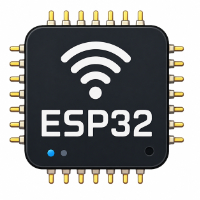
Microcontroller ESP32
The ESP32 is the core of many data acquisition systems. It collects data from connected sensors and delivers it via USB, Wi-Fi, or Bluetooth to applications, dashboards, and web-based platforms for visualisation and analysis.
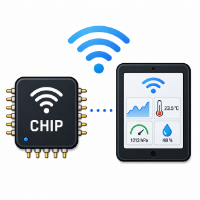
Wi-Fi Connection
Connecting the Microcontroller to a PC or Tablet
Connecting a microcontroller to a computer or tablet via Wi-Fi requires a few additional setup steps. Follow our detailed guides or watch the video tutorials to get started quickly.
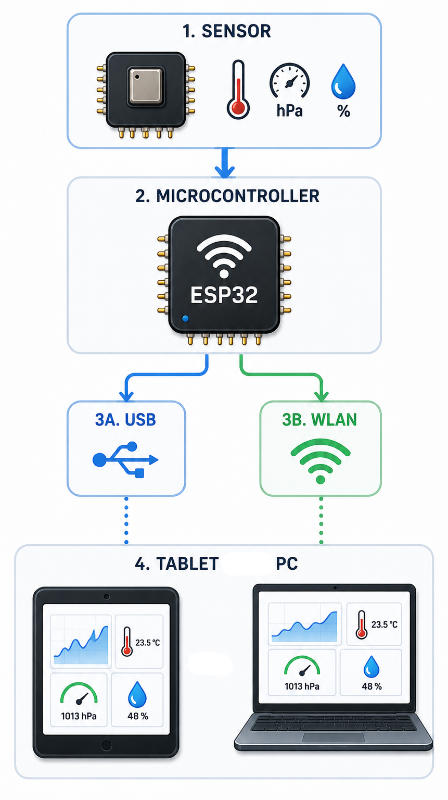
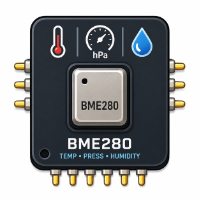
BME280 Sensor
The BME280 sensor measures temperature, air pressure, and relative humidity. Learn how the data is transferred to a computer for visualisation and analysis.
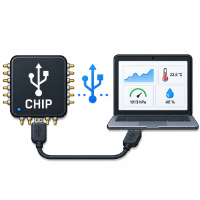
USB Connection
Microcontroller to Computer
Connecting a microcontroller to a PC via USB-C is simple and reliable. USB can also be used to configure your ESP32 directly from the browser. For tablets, we currently recommend using a Wi-Fi connection instead.
Measure the Real World
Discover the sensors behind weather stations, energy monitoring, thermal imaging, distance measurement, and IoT projects.
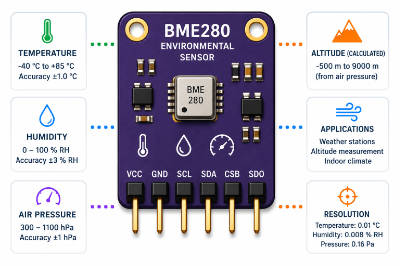
BME280
Temperature, Air Pressure, Humidity
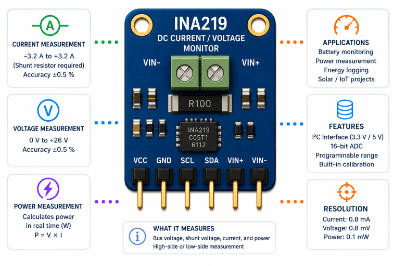
INA 219/INA226
Measuring Current, Voltage and Power
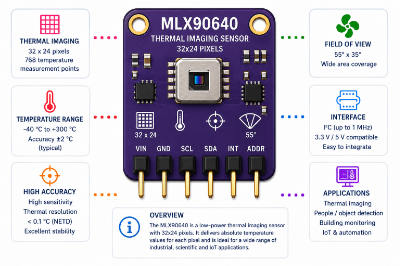
MLX90640
IR Sensor - Temperature Field 32x24 Pixels
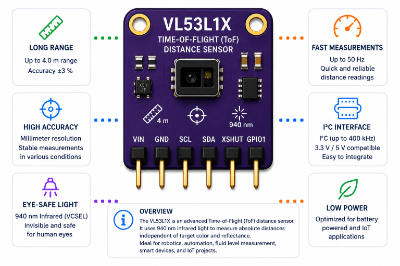
VL53L1X
IR Laser for Distance Measurement
The most popular sensors for learning, experimenting, and building data-driven projects.
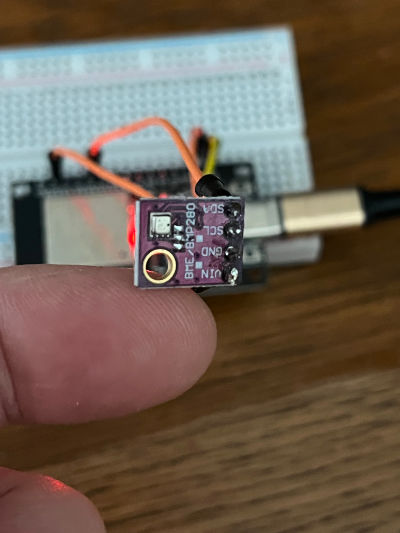
ESP32 Weather Station
with BME280 Sensor
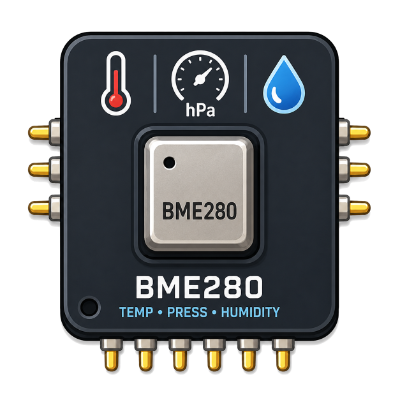
Diagram of the sensor above.
Live setup shown in the image below!
Capabilities of the BME280 Sensor: Measures temperature, air pressure, and humidity
The BME280 is a compact digital environmental sensor. It simultaneously measures temperature, air pressure, and humidity, making it ideal for weather stations, smart home projects, educational experiments, and IoT applications using the ESP32 or Arduino.
Standard Ranges
| Parameter | Dynamic range |
|---|---|
| Temperature | −40 °C to +85 °C |
| Air Pressure | 300 hPa - 1100 hPa |
| Humidity | 0 % - 100 % |
Measuring accuracy
| Parameter | Accuracy |
|---|---|
| Temperature | ±1 °C |
| Air Pressure | ±1 hPa |
| Humidity | ±3 % |
Features
- Digital communication via I²C or SPI
- Very low power consumption
- Compact size
- Good long-term stability
- Ideal for ESP32, Arduino, and Raspberry Pi
Typical Applications
- Weather stations
- Indoor climate monitoring
- Altitude measurement via air pressure
- Physics and computer science classes
- Smart home and IoT projects
- Data logging and web dashboards
The BME280 provides stable readings and is particularly popular because it allows temperature, air pressure, and humidity to be measured simultaneously using a single sensor.
Why SensorLab?
Today, we are surrounded by data. Weather forecasts, smart homes, renewable energy systems, industrial automation, and scientific research all rely on sensors that continuously measure and analyse the world around us.
Yet for many people, sensors and data acquisition still seem complicated, expensive, or difficult to access. SensorLab was created to change that.
The idea behind SensorLab is simple: measuring real-world phenomena should be as easy as viewing a website. Modern microcontrollers and sensors are now affordable enough for students, teachers, makers, hobbyists, and anyone interested in science and technology. With the right tools, it is possible to build powerful measurement systems without specialised equipment or extensive programming knowledge.
SensorLab focuses on practical learning and experimentation. Instead of only reading about physics, electronics, environmental science, or data analysis, users can collect their own measurements, visualise live data, and explore how real systems behave.
Whether it is monitoring the weather, analysing solar energy production, measuring temperature changes, investigating magnetic fields, or exploring motion and oscillations, SensorLab helps transform abstract concepts into visible and measurable experiences.
Our goal is to make modern measurement technology accessible, understandable, and enjoyable for everyone.
SensorLab FAQ
Common questions about SensorLab.world, ESP32 sensor projects, live data dashboards, USB and Wi-Fi data acquisition, and classroom use.
What is SensorLab.world?
SensorLab.world is a platform for simple, affordable sensor projects using microcontrollers, real-world measurements, and interactive web dashboards.
Who is SensorLab for?
SensorLab is designed for students, teachers, makers, hobbyists, and anyone interested in measuring and visualising real-world data.
Which microcontroller does SensorLab use?
Most SensorLab projects are based on the ESP32, a low-cost microcontroller with built-in Wi-Fi, Bluetooth, USB communication, and strong support for many sensors.
Which sensors can be used with SensorLab?
Typical sensors include the BME280 for temperature, pressure and humidity, INA226 for current and voltage, DS18B20 for waterproof temperature measurements, QMC5883L for magnetic fields, VL53L1X for distance, and MLX90640 for thermal imaging.
Do I need expensive laboratory equipment?
No. SensorLab focuses on affordable hardware such as ESP32 boards and low-cost sensor modules. Many experiments can be built with simple components and a normal computer.
Can SensorLab dashboards run in a web browser?
Yes. SensorLab dashboards are designed to run directly in a modern browser. Data can be displayed live, recorded, visualised in charts, and exported for further analysis.
Can I use USB instead of Wi-Fi?
Yes. USB is ideal for classroom use, setup, and faster measurements. On desktop computers, Chrome and Edge can communicate with an ESP32 via the Web Serial API.
Can SensorLab be used with tablets?
Tablets are well suited for Wi-Fi dashboards and viewing live data. Direct USB communication is mainly recommended for desktop computers using Chrome or Edge.
Can students export measurement data?
Yes. Measurement data can be exported as CSV files and opened in spreadsheet applications such as Numbers, Excel, or Google Sheets for creating charts and analysing results.
Is SensorLab suitable for schools?
Yes. SensorLab is especially useful for STEM education, physics experiments, environmental monitoring, energy projects, data analysis, and hands-on classroom activities.